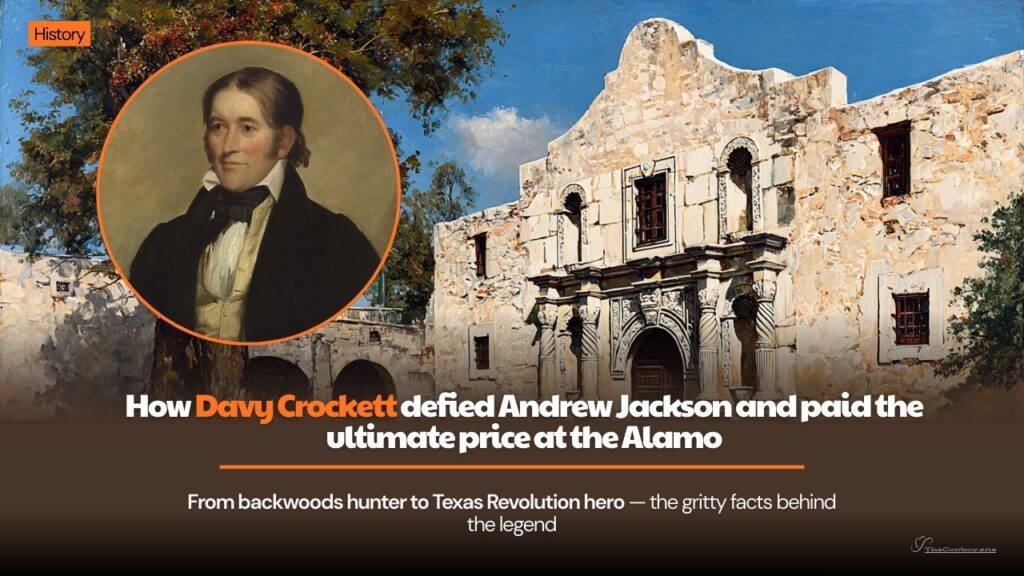
Born August 17, 1786, in a small cabin along the Nolichucky River in what is now Greene County, Tennessee, David Crockett came into the world with nothing but frontier blood in his veins. His father John had fought as an Overmountain Man at Kings Mountain during the Revolutionary War. Young Davy knew hardship early. At age 12 he was indentured to help pay family debts, herding cattle hundreds of miles through the wilderness. He ran away, worked odd jobs, and eventually returned home to settle debts through years of hard labor.
By 1813, when the Creek War broke out after the Fort Mims massacre, Crockett enlisted as a scout. He served under Andrew Jackson, hunting game to feed the troops. He re-enlisted in 1814 as a sergeant and stayed until the war’s end. Those years taught him survival, leadership, and the cost of conflict.
Back home he built a life in Lawrence County, serving as justice of the peace and militia colonel. In 1821 voters sent him to the Tennessee General Assembly. He fought for poor settlers against unfair land taxes and supported William Carroll for governor. Elected to the U.S. House of Representatives in 1827, Crockett quickly became known for his plain speech and independence. He was the only member of the Tennessee delegation to vote against Jackson’s Indian Removal Act in 1830, calling it “wicked” and “unjust.” That stand cost him politically.
Defeated in 1831 and again in 1835, Crockett had enough. He told supporters that if they wanted someone else, they could go to hell and he would go to Texas. In November 1835 he left Tennessee with a small group of volunteers. He signed an oath to the Provisional Government of Texas and arrived at the Alamo Mission on February 8, 1836.

Santa Anna’s Mexican army surrounded the fort on February 23. Crockett and his men helped defend the low wall in front of the church. On March 6, after a 90-minute battle, every defender was killed. Historical accounts confirm Crockett died that day, though details of his final moments remain debated. His body was burned with the others.
Crockett’s life became legend almost immediately. Almanacs, stage plays, and especially Walt Disney’s 1950s television series turned him into the coonskin-capped King of the Wild Frontier. Yet the real man was far grittier: a hunter, soldier, politician, and volunteer who never quit even when he had lost everything.
Today statues stand in his honor across Tennessee and Texas. Schools, counties, and parks carry his name. His famous saying — “Be sure you’re right, then go ahead” — still echoes on ranches and trail rides. Davy Crockett didn’t just live the cowboy code. He died by it. And that is why his story still fires up every person who believes in standing tall when the odds are stacked against you.