In 1889, two Kansas towns went to war over a county seat. Discover the true story behind the Battle of Cimarron and how paperwork sparked a Wild West gunfight.
When people think of the Old West, they usually picture gunfights over cattle, gold, or land. The Battle of Cimarron proves that sometimes, the most dangerous fights weren’t over riches at all — they were over power, pride, and paperwork.
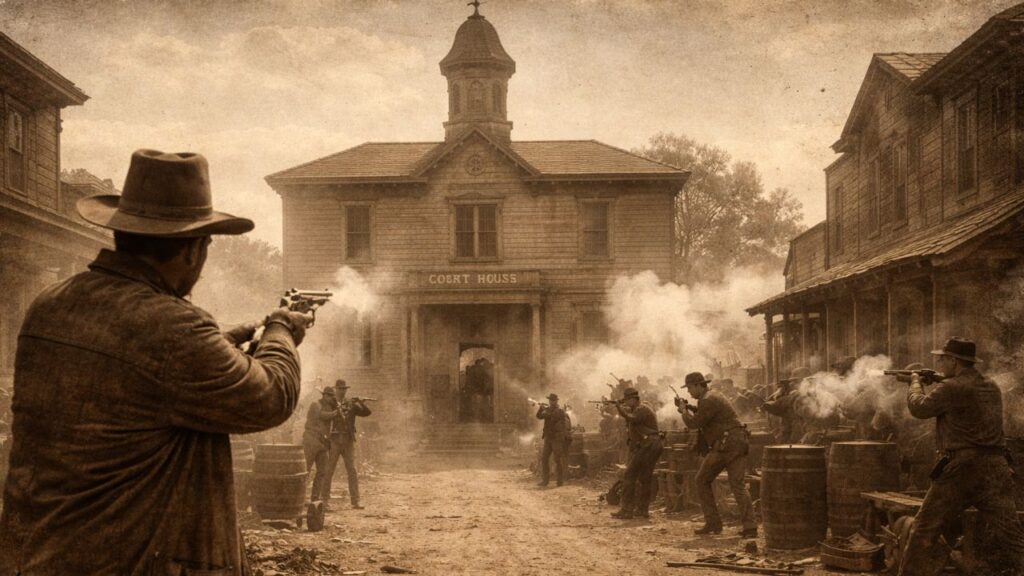
In 1889, Gray County, Kansas, was still young and growing. Two towns, Cimarron and Ingalls, were competing for one title that could decide their future: county seat. Holding the county seat meant hosting the courthouse, controlling official records, attracting businesses, and securing long-term survival. For frontier towns, this wasn’t a small honor — it was everything.

An election was held to settle the matter. Cimarron won.
Ingalls immediately disputed the results, claiming voter fraud and illegal ballots. As accusations flew, tensions rose fast. In the West, legal disagreements didn’t always stay in courtrooms — especially when livelihoods were on the line.
Ingalls decided to take action.
A group of men led by law officers, including the well-known lawman Bill Tilghman, formed a plan to physically remove the county records from Cimarron’s courthouse. Their reasoning was simple: if Ingalls had the records, it could claim the county seat regardless of the election.
They arrived in Cimarron expecting resistance, but not what followed.
Armed citizens of Cimarron were already waiting.
What began as a raid quickly turned into a full-scale gunfight. Shots rang out in the streets. Bullets struck buildings. The courthouse, meant to represent law and order, became the center of chaos. The battle lasted several hours, with multiple men wounded and at least one killed.
This wasn’t a quick scuffle — it was a violent standoff driven by stubborn pride on both sides.
In the end, the raid failed. The county records were never taken. Cimarron remained the county seat, and the courts later upheld that decision. Ingalls lost not just the battle, but the war for control of Gray County.
The Battle of Cimarron stands as a reminder that the Old West wasn’t lawless simply because people ignored rules — it was lawless because the rules themselves were still being fought over. Power wasn’t always decided by courts or ballots. Sometimes, it was decided by who showed up armed and willing to stand their ground.
Unlike famous Western shootouts driven by revenge or crime, this conflict grew out of something far more ordinary: local government. That’s what makes it so striking. A disagreement over records, titles, and legitimacy escalated into bloodshed because neither side was willing to back down.
Today, the Battle of Cimarron is remembered as part of the Gray County Seat War — a cautionary tale from the frontier era. It proves that even the smallest decisions, when mixed with pride and fear, can explode into something much larger.
In the Old West, it wasn’t always gold or guns that started fights.
Sometimes, it was just a courthouse full of papers — and what they meant to the people who believed their future depended on them.