Most conversations about American farmland focus on who owns it. Foreign investors. Corporate buyers. Developers. But there is a second conversion happening across the rural landscape that gets far less attention — one driven not by foreign governments or Wall Street, but by the growing demand for domestic energy.
Quick Takeaway
- 1.25 million acres of U.S. farmland have already been converted to solar development
- 83% of all projected future solar development will land on agricultural land
- Half of that will be on the nation’s most productive farmland
- 10.4 million acres will be needed for utility-scale solar by 2050 — 90% in rural communities
- The 2026 Farm Bill now prohibits USDA funding for solar on prime farmland
- A growing middle-ground called agrivoltaics allows crops and solar to share the same land
Solar development is arriving in American farm country at a pace that is raising serious questions about how much productive agricultural land will remain available for food production in the decades ahead.
The numbers are still relatively modest today. The American Farm Bureau Federation estimates that 1.25 million acres of farmland have been converted to solar development — less than half of one percent of the country’s total agricultural land. There are currently 7.25 million acres of solar arrays nationwide across all land types.
But the trajectory of where those numbers are heading is what has researchers, farmers, and policymakers paying close attention.

The Kind of Land Being Targeted
Not all land is equal, and the concern among agricultural groups is not simply about volume — it is about which land is being selected for solar development.
According to the USDA’s Economic Research Service, of more than 3,000 utility-scale solar projects built in rural areas between 2012 and 2020, 43% were built on cropland. In the Midwest — the agricultural heartland of the country — that figure rises to 70% of solar projects covering productive agricultural acres.

Farmland is attractive to solar developers for the same reasons it is valuable to farmers: flat terrain, open sun exposure, cleared ground, and proximity to existing infrastructure. The qualities that make land good for growing food are the same qualities that make it ideal for generating power. That overlap is at the heart of the tension.
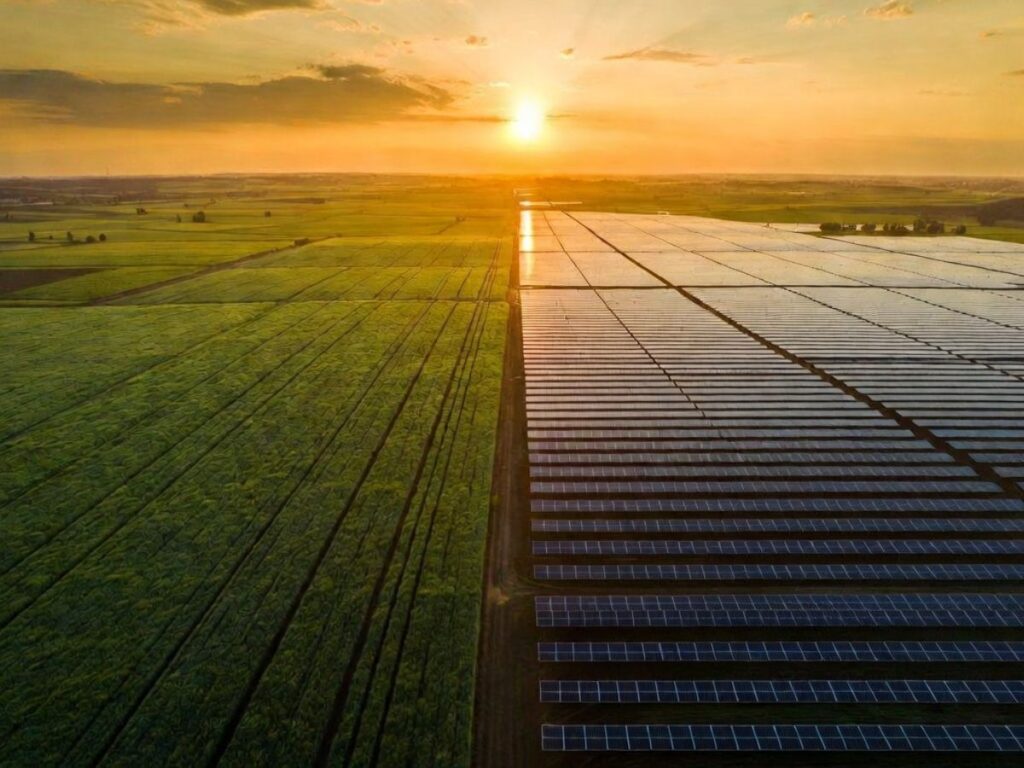
Solar farms are increasingly muscling into U.S. farmland as energy demands spike, driven in part by the explosive growth of data centers, AI infrastructure, and electric vehicle charging networks — all of which require massive amounts of new power generation.
The 2050 Projection
The current 1.25 million acres represents where things stand today. The more significant number is where they are heading.
The Department of Energy projects that achieving a decarbonized electric sector by 2050 will require converting 10.4 million acres of land to solar energy generation — with 90% of that development occurring in rural communities. The American Farmland Trust projects that without policy interventions, 83% of that new solar development will land on agricultural land — and that 49% of it will be on the nation’s most productive farmland, what the AFT classifies as “nationally significant” for its crop-producing capacity, versatility, and resilience.
To put that in context: 10.4 million acres is roughly the size of Maryland and Connecticut combined. And the majority of it is currently growing food.
Does Solar on Farmland Threaten the Food Supply?
This is the central question, and the research offers a more nuanced answer than either side of the debate typically acknowledges.
A 2026 study from Indiana University researchers examined how replacing cropland with utility-scale solar would affect land allocation, crop prices, and farm revenue across the United States. Their findings showed that even under a scenario where 40% of future solar projects sit on cropland, prices for corn, soybeans, and wheat increase by less than 5.6% — a figure the researchers described as negligible at the national commodity market level.
The counter-argument from agricultural groups is that national commodity price models do not capture what happens at the local and regional level — particularly in communities where the land being converted is the primary economic driver, and where once productive soil is permanently removed from agricultural use. Once solar panels go in and the land is graded and compacted, returning it to crop production is neither simple nor guaranteed.
A Third Option — The Rise of Agrivoltaics
Between the binary of “solar farm” and “working farm” a third model is gaining traction: agrivoltaics, which places solar infrastructure and agricultural production on the same land simultaneously.
Agrivoltaic installations can boost land-use efficiency by 60 to 200 percent while reducing crop water demand by 20 to 50 percent in arid climates. More than 600 U.S. sites are currently using sheep to graze beneath solar panels — keeping vegetation managed while maintaining active livestock operations on the same ground. Field trials have shown that certain crops including leafy greens produce higher yields under panel shade than in open fields.
The global agrivoltaics market surpassed $5.6 billion in 2025 and is projected to exceed $9.3 billion by 2030. Whether it scales fast enough to meaningfully offset traditional farmland conversion remains an open question.
Where Federal Policy Stands
The federal government has begun responding to the tension. In August 2025, USDA Secretary Rollins blocked taxpayer dollars from being used to fund solar development on prime farmland — a significant policy shift that drew both praise from agricultural groups and criticism from energy developers.
The American Farmland Trust has advocated for a “Smart Solar” framework that would steer solar development toward already-degraded land, rooftops, parking lots, and brownfields — preserving prime agricultural ground for food production while still meeting national energy goals. The 2026 Farm Bill includes a prohibition on USDA financial assistance for solar projects on prime, unique, or locally significant farmland.
The Bigger Picture
The United States currently produces enough food to feed its own population and export to much of the world. That capacity rests on a finite base of highly productive agricultural land — land that took thousands of years of natural processes to develop and cannot be manufactured or replaced once it is paved, graded, or permanently converted.
The 1.25 million acres already under solar panels represents a fraction of that base. The 10.4 million acres projected by 2050 represents something more consequential — particularly if the majority of that development lands on the nation’s most productive ground.
The decisions being made right now about where solar goes — and what policy frameworks govern those decisions — will shape the American food and energy landscape for generations. Both conversations are worth having at the same time.