In Coweta County, Georgia, a single mother named Angela Hall bought a home through a government loan program in 2003. Her daughter Ansley was five years old when they moved in. Ansley grew up in that house — she says it made her who she is. Angela Hall described where she started: “I was a very poor single mother. I lived in a housing project when Ansley was tiny. I worked my butt off for this house.”
Georgia Power wants to take it.
Not because of a highway. Not because of a school or a hospital or a public works project. According to the Atlanta Journal-Constitution, the 35-mile, 500-kilovolt transmission line cutting through Coweta and Fayette counties was designed specifically to deliver power to AI data centers.
Quick Takeaway
- Georgia Power is building a 35-mile transmission line through Coweta and Fayette counties specifically to serve AI data centers
- The $16 billion grid expansion was approved by the Georgia Public Service Commission in December 2025
- More than 330 property owners are targeted for easement acquisitions; between 20 and 30 homes are slated for full demolition
- Georgia Power has invoked eminent domain against homeowners who have not agreed to its offers
- Georgia Power has signed data center contracts totaling more than 9,000 megawatts — 80% of all new generation capacity is earmarked for data centers
- The average Georgia Power residential bill has climbed from $150 to $225 per month over the past two years
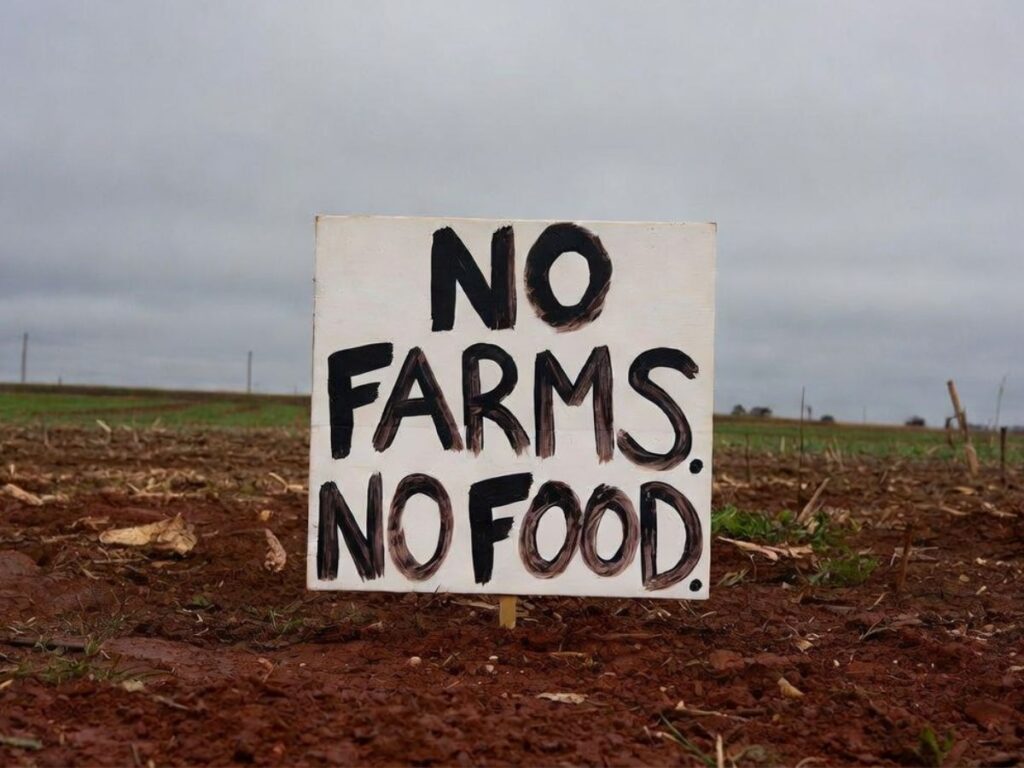
- Residents are organizing under the slogan: No Farms. No Food.
What Project Wansley Is — and Who It Serves
The transmission line is part of a broader infrastructure buildout called Project Wansley. The Georgia Public Service Commission approved Georgia Power’s $16 billion grid expansion plan in December 2025, giving the utility the authority to begin acquiring land and invoking eminent domain along the corridor.
The scale of what is being built is significant. According to the Georgia Public Service Commission’s own data center fact sheet, Georgia Power has signed contracts with data centers totaling more than 9,000 megawatts of power capacity. Approximately 80% of all new generation capacity Georgia Power is building over the next five years is earmarked for those data centers — not for homes, not for farms, not for the communities the utility has served for generations.
In April 2026, Georgia Power broke ground on a new natural gas plant at the Plant Wansley site in Heard County to help meet that demand. The infrastructure being built is enormous in scale. The footprint it requires is coming out of private property.
330 Property Owners. 21 Homes Demolished.
The 35-mile transmission corridor does not run through empty land. According to reporting by Crypto Briefing, more than 330 property owners have been targeted for easement acquisitions along the route. Between 20 and 30 homes are slated for full demolition to make way for the line.
Residents say they were given insufficient notice and that the offers they received from Georgia Power do not reflect what their properties are worth. WSB-TV in Atlanta reported on homeowners battling Georgia Power over land acquisition offers they describe as far below fair market value.
For Angela Hall and her daughter Ansley, the dispute became public when Ansley posted a TikTok video about their situation. It went viral. According to 11Alive News, Georgia Power increased its offer only after the video gained public attention — a timeline the family says speaks for itself. Georgia Power states it offered 125% above the appraiser’s valuation. The family disputes the characterization of how those negotiations unfolded.
Georgia Power maintains that eminent domain is used in fewer than 1% of its land acquisitions and that it frequently offers above market value. For the families whose properties fall within that 1%, the statistic offers little comfort.

Who Is Actually Paying for This
The residents losing their land are not the only Georgia Power customers absorbing the cost of this buildout. According to Axios Atlanta, the average monthly Georgia Power residential bill has climbed from approximately $150 to $225 over the past two years — an increase of more than $43 per month.
The Georgia Public Service Commission ordered a freeze on Georgia Power base rates through 2028 and has stated that new large-load customers like data centers must pay the costs needed to serve them. But the Southern Environmental Law Center stated that the PSC unanimously approved Georgia Power’s expansion plan without sufficient customer protections, and that some construction, fuel, and financing costs are still being distributed across the broader customer base.
Regular Georgia Power customers are watching their bills rise while a grid is built primarily to serve data centers. Some of them are also being asked to give up their land to make that grid possible.
The Community Fighting Back
A Coweta County farmer’s emotional public plea against the eminent domain process went viral, drawing national attention to what had been a local fight. Residents along the corridor have begun organizing under a slogan that connects the issue directly to food and land: No Farms. No Food.
The opposition reflects a concern that goes beyond any single property. Rural land in Georgia — farmland, family homes, generational holdings — is being placed in the path of infrastructure that exists to serve one of the wealthiest industries in the history of the American economy. The communities bearing the cost of that infrastructure did not choose to bear it. They were not meaningfully consulted before the project was approved. And they are being asked to accept offers that many say do not reflect what they have built over a lifetime.
The Bigger Pattern
Georgia is not alone in this. Across the country, the AI and data center boom is driving demand for new power generation and transmission infrastructure at a pace that existing grids cannot meet. That infrastructure has to go somewhere. In most cases, it is going through rural land — through farms, through family properties, through the kind of communities that do not have the political weight to push back the way a city might.
The same energy demand driving the Stratos Project in Utah, the solar farmland conversion across the Midwest, and the Colorado River water fights in the West is now running a transmission line through a single mother’s backyard in Coweta County, Georgia.
Angela Hall worked her way out of a housing project to buy that house. Her daughter grew up in it. And a utility company with $16 billion in approved grid expansion authority and a legal right to condemn private property is telling her what it is worth.
Residents have until the courts — or the public pressure — say otherwise.