There is a rancher in Kentucky who raises cattle the right way — grass-fed, open pasture, no corners cut. There is a small processor twenty minutes down the road who has been slaughtering livestock for that county for three decades. And there is a restaurant in the same town that would gladly put that beef on its menu.
Under current federal law, that transaction is illegal.
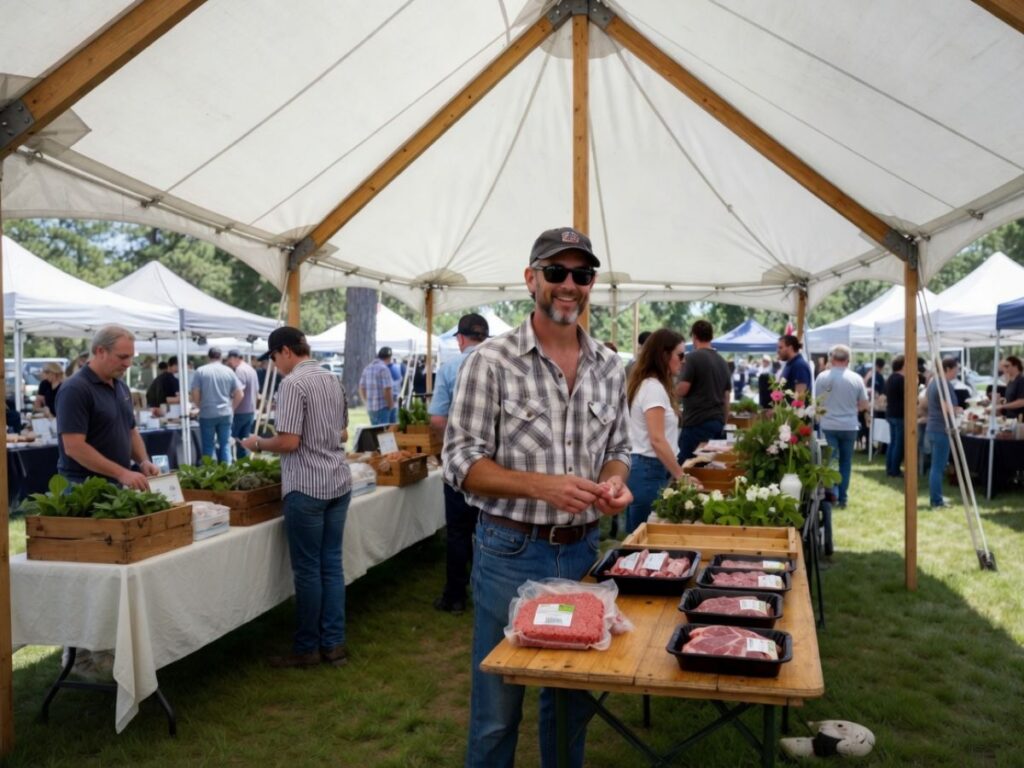
The rancher can have the processor slaughter the animal and return the packaged beef to the rancher personally. But the moment that same processor tries to sell that meat to the restaurant — or to a neighbor, or to a local grocery store — federal law requires the facility to carry a full-time USDA inspection program. Most small processors in America cannot afford one. So the local supply chain that should exist, doesn’t.
The PRIME Act — the Processing Revival and Intrastate Meat Exemption Act — is the bill designed to fix that. It has been introduced in Congress multiple times, most recently by Representative Thomas Massie of Kentucky. It has not yet passed. And the fight over it reveals exactly who has power in the American food system and who doesn’t.
Quick Takeaway
- The PRIME Act would allow custom-exempt meat processors to sell directly to consumers, restaurants, and grocery stores within the same state — without federal USDA inspection
- Under current law, small processors can slaughter your animal and hand it back to you — but they cannot sell that same meat to anyone else
- A USDA-inspected facility costs $90,000 or more per year just to staff the required on-site federal inspector — a barrier most small operations cannot clear
- State inspection programs, civil liability, and labeling requirements would still apply — the federal daily inspector requirement is what the PRIME Act removes
- Nearly every major E. coli outbreak and mass recall in recent decades has originated in large industrial facilities, not small local processors
- The bill has been introduced multiple times in Congress, sponsored by Rep. Thomas Massie (R-KY), but has not yet passed
What the Current System Actually Requires
Federal inspection isn’t a one-time certification — it’s a daily cost that only large operations can absorb.
When most people hear “USDA-inspected,” they picture a stamp on a package. What it actually means is a federal inspector physically present at the facility during every hour of slaughter. Not a quarterly audit. Not a surprise visit. Every single operating day.
That inspector is a federal employee. The facility does not pay the inspector’s salary directly, but it is required to operate on a schedule that accommodates federal staffing — and USDA requires facilities to cover overtime costs when they process outside normal hours. USDA’s own grant program for small and very small meat processors acknowledges that the cost of maintaining federal inspection is one of the primary barriers keeping small processors out of the legal commercial market.
A facility processing 10 animals a week faces the same daily inspection requirement as a plant processing 5,000. The overhead is not scaled to the operation. It is a flat barrier — and for most small processors, it is an insurmountable one.
The result is a two-tier system. Large industrial meatpackers — Tyson, JBS, Cargill, National Beef — operate with federal inspection and dominate retail distribution. Small local processors exist in a legal gray zone: they can serve individual owners under a “custom exempt” designation, but they cannot participate in commercial sales. According to the Farm-to-Consumer Legal Defense Fund, the custom exempt loophole means a rancher can technically get their animal processed locally — but selling that meat commercially requires jumping through a federal hoop that is deliberately sized for industrial players.
What the PRIME Act Would Change — and What It Would Not
This is not a deregulation free-for-all. It is a targeted fix to one specific federal requirement.
The PRIME Act does one thing: it expands the custom exempt designation to allow small processors to sell meat from custom-slaughtered animals to consumers, restaurants, hotels, and grocery stores — as long as the sale stays within the same state. It does not eliminate inspection. It does not override state law. It does not apply to interstate commerce. The bill’s text makes clear that it operates entirely within existing constitutional limits on what states can regulate for themselves.
What stays in place after the PRIME Act passes — if it passes:
- State meat inspection programs, which in most states already meet or exceed federal standards and are certified as equivalent by USDA
- State health and food safety laws covering processing facilities
- Labeling requirements — meat processed under the custom exempt expansion must be clearly identified as not federally inspected
- Civil liability — if a consumer gets sick from a product, the rancher and processor are still legally exposed
- The rancher’s own direct accountability to the buyer, who in most cases knows exactly where the animal came from
The daily federal inspector requirement is the specific layer the PRIME Act removes for intrastate sales. That is the entire scope of the change.
The Food Safety Question — and the Honest Answer
Opponents say removing federal oversight creates risk. The data on where outbreaks actually happen tells a different story.
Food safety advocates make a legitimate point when they argue that federal inspection provides a consistent national standard and that removing it creates variation from state to state. That concern deserves a straight answer, not dismissal.
But the actual outbreak record cuts the other way. The CDC’s multistate foodborne illness outbreak data shows that the contamination events that have sickened thousands of Americans — the E. coli recalls, the Listeria outbreaks, the mass recalls affecting products in 40 states — have come almost exclusively from large federally inspected industrial facilities. Not from a small processor slaughtering 15 animals a week for a county of people who know the rancher by name.
The risk profile of a small local processor is fundamentally different from a plant processing millions of pounds of ground beef per day. In an industrial plant, a single contaminated batch can reach a hundred different retailers in thirty states before anyone notices. In a local operation selling to people in the same county, the supply chain has three steps and a name attached to every one of them.
The PRIME Act’s supporters argue that traceability — knowing exactly which ranch, which animal, which processor — is a stronger consumer protection than a federal inspector who sees thousands of carcasses a day across dozens of facilities. Rep. Massie has consistently made this case, pointing out that the inspection requirement was designed for industrial-scale meatpacking, not for the small-scale local food systems that the law effectively prohibits.
Who Is Fighting It — and Who Stands to Lose If It Passes
The opposition to the PRIME Act isn’t coming from consumers worried about food safety. It’s coming from the processors that benefit from keeping small competitors out of the market.
The North American Meat Institute — the lobbying arm of the large meatpacking industry — has opposed the PRIME Act. The stated reason is food safety.
The four largest beef packers in the United States — Tyson, JBS, Cargill, and National Beef — control roughly 80% of the country’s beef processing capacity. USDA’s own Packers and Stockyards reporting has documented the concentration of market power in beef processing for years. That concentration did not happen because big processors out-competed small ones on merit — it happened in part because the regulatory framework made it nearly impossible for small processors to legally compete in the commercial market.
The inspection requirement functions as a moat. The large processors cleared it decades ago and built their operations around it. The PRIME Act would lower the drawbridge for small local processors — which is exactly why the industry that benefits from the current system has reasons to keep it in place, dressed up in the language of food safety.
Where the Bill Stands Right Now
The PRIME Act has enough support to keep getting introduced. It doesn’t yet have enough to pass. That math could change.
The PRIME Act has been introduced in multiple Congresses over the past decade. It has picked up bipartisan support — including from lawmakers who do not normally agree on much — because the underlying problem it addresses is real and visible in rural communities across the country. The current version was introduced in the 119th Congress and has been referred to committee.
The bill has not passed because the lobbying weight of the industrial meatpacking sector outweighs the political voice of the ranchers and small processors who would benefit. That is a blunt assessment, but it is accurate.
What has changed in the current environment is the broader political mood around food sovereignty, local supply chains, and skepticism of large corporate food producers. The PRIME Act fits cleanly into a growing bipartisan coalition — ranchers and rural conservatives who want market freedom, and local food advocates who want shorter supply chains and regional food security. The Farm-to-Consumer Legal Defense Fund continues to push for passage and tracks co-sponsorship as the bill moves through committee.
For ranchers who have watched a neighbor’s small processing operation shut down because it couldn’t afford to go federally inspected — and watched their own options for selling direct narrow as a result — the PRIME Act is not a policy debate. It is the difference between a viable local food economy and one that keeps funneling cattle through four companies that control 80% of the market.